


The Frog Club: A Dad’s 3-Step Guide to Teaching Water Confidence
There is a specific kind of panic that happens in a dad’s chest when you take your kids to a public pool, and they refuse to let go of your neck. They are death-gripping your collarbones, their eyes are wide, and every splash from a nearby cannonball sends them climbing up you like a tree.
Years ago, I realized I didn’t need my kids to master a perfect Olympic freestyle stroke right away. I just needed them to feel safe. I needed them to know that the water wasn't an enemy to fight, but a playground to explore. Most of all, I wanted them to trust their own bodies.
So, I threw out the traditional rulebook and started The Frog Club.
Disclaimer: I am not a certified swim coach. This isn't about teaching perfect form or backstroke mechanics. This is a dad’s homegrown blueprint for building pure, unshakeable water confidence through play, imagination, and a few techniques to help your kids move through the pool like they own it.
If you want to turn pool time from a high-stress negotiation into their favorite summer memory, here are the three steps to earning life membership in The Frog Club.
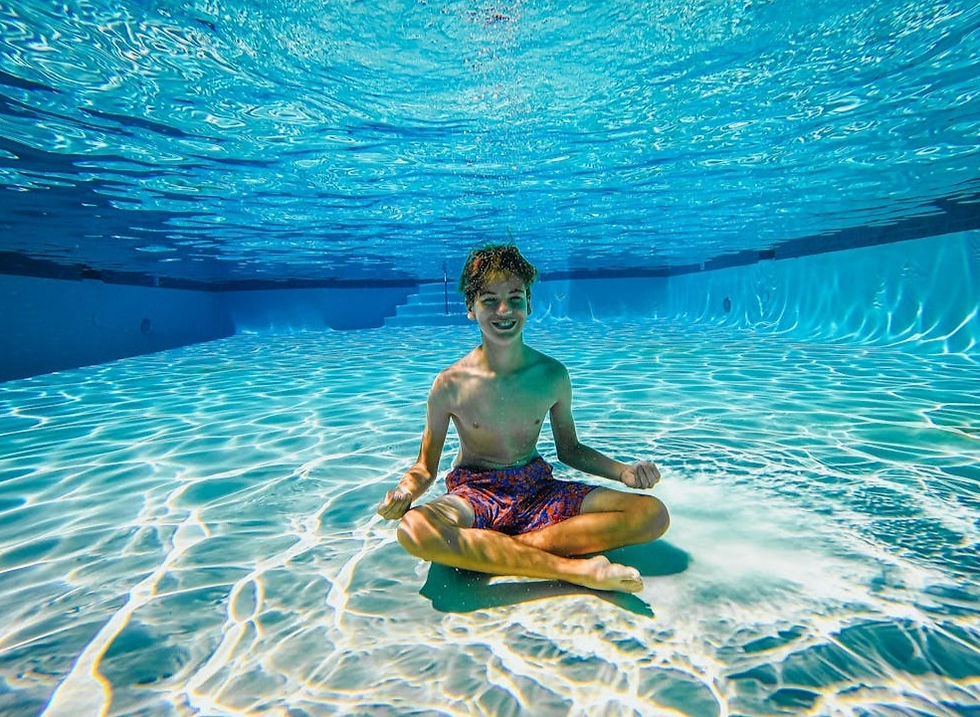
Level 1: The 3-Second Floor Sit ☝️✌️🫳
Every kid starts the day clinging to the pool wall like a barnacle. That’s fine. Let them splash, let them acclimate, and let them get their bearings. But once the initial hesitation wears off, it’s time to drop the hook.
I look them in the eye and ask: "Are you ready to try out for The Frog Club?"
Kids love exclusive memberships. Once they enthusiastically say yes, I lay out the initiation test: They have to drop to the bottom of the pool, sit on the floor, and count to three using their fingers. Literally—drop down, hold up one finger, two fingers, three fingers, and come back up to the wall. They can hold their nose if they want to.
The first few times, they think this is going to be a breeze. Then, physics kicks in.
They dunk under, and their bodies instantly pop right back up to the surface like a cork. They try again, kicking furiously, but they can't stay down. Their lungs, fully inflated with air, act like balloons pulling them upward. It feels completely impossible to them, and they usually pop up wide-eyed and frustrated.
That’s when I offer the secret Frog Club tip: “You have to blow out some bubbles on your way down.”
By exhaling a little bit of that air as they submerge, they neutralize the "balloon effect." Once they get comfortable with empty lungs, they can easily sink, touch the bottom, plant their feet, and JUMP off the floor to propel themselves back to the surface.
Why This Matters (The Dad Secret):
While the kids think they are just passing a funny club initiation, you are actually installing two massive milestones in their water safety:
The Self-Recovery Loop: You are teaching them exactly how to get back to the surface if they ever find themselves in water over their head.
Sub-Surface Comfort: It completely reframes how they view the water below them. Instead of a scary, bottomless void, the floor of the pool becomes a solid launching pad. They realize that if they ever feel panicked or tired, they don’t have to fight the water—they can just sink, touch the bottom, and bounce right back up.
Once they can sink, count to three, and launch themselves up to grab the wall, congratulations: they’ve officially passed Level 1.
Level 2: Float on Your Back and Octopus Swim 🐙
Once your kid realizes the bottom of the pool isn't a scary void, it’s time to teach them how to conquer the surface. Welcome to Level 2: The Octopus Swim.
For this level, the goal is to get them floating completely relaxed on their back, arms and legs extended like starfishes, looking up at the sky. Once they are stable, they will use a smooth, bird-like flapping motion with their arms—keeping their legs completely still—to propel themselves backward. When done right, they look exactly like a calm octopus or squid gliding effortlessly through the ocean.
But getting a kid to lie flat on their back in the water is a massive mental hurdle.
When you first try it, you’ll need to support them. Place a single hand right in the center of their lower back to give them a safety net. Within a few seconds, they’ll face their first challenge: as they breathe out, they will start to sink. Their natural survival reflex will kick in—they’ll drop their hips, bend at the waist, and try to "sit up" and dog-paddle.
To help them fight that instinct, you're going to bring back the science from Level 1, but in reverse.
Give them the secret Octopus tip: “Remember the balloon trick? This time, we want to keep the balloons full. Take a deep breath to fill your chest up, and then take quick, smaller breaths so your lungs stay inflated and keep you floating.”
Spend a few minutes practicing just that—resting on your hand, keeping the hips high, and mastering those "balloon breaths." Once they can calmly relax on top of the water without your hand supporting them, lay down the ultimate graduation challenge:
“Now, without kicking your legs, I want you to smoothly and calmly flap your arms like a bird.”
No splashing. No frantic kicking. Just smooth, rhythmic arm sweeps that pull them through the water. If they can successfully navigate the shortest path across the pool using only their octopus tentacles, they have officially unlocked Level 2.
Why This Matters (The Dad Secret):
This isn't just a cool party trick to show off to the other parents at the pool. You are secretly handing your kids a literal life-jacket made of pure confidence.
Tragically, exhaustion is a major factor when kids get into trouble in deep water. They panic, they try to fight gravity, and they tire themselves out. By mastering the Octopus Swim, your kids now have an automatic panic-button. If they ever get tired or overwhelmed while playing in the deep end, they don't have to fight. They can just flip over onto their back, let the water hold them up, catch their breath, and calmly "octopus" their way back to safety or a wall.

Level 3: The Torpedo Swim 🚀
Now that your kids know how to handle the bottom of the pool and rest on the surface, it’s time for the grand finale. Level 3 is all about speed, efficiency, and pure fun. Welcome to The Torpedo Swim.
For this final challenge, we head to the pool wall. I tell the kids they are about to become underwater missiles.
The instructions are simple: Drop down below the surface (using their Level 1 bubble-blowing trick), let go of the wall, and plant both feet firmly against the wall of the pool. Then, with everything they’ve got, they push off in a massive burst of power, locking their arms straight above their head and locking their legs together.
The rule is: "Don't swim. Don't kick. Just turn your body into a rigid pencil and see how far the blast takes you."
Once they feel their momentum finally start to slow down, they simply plant their feet, kick off the floor, pop up to the surface, and wave to me to show me how far they got.
When you watch this from above, they look exactly like torpedoes launching through the deep.
Naturally, this instantly turns into a competition. They’ll try it again and again, trying to beat their own distance marker. Pretty soon, they’ll organically start adding a few flutter kicks at the end of the glide to squeeze out a few extra feet, all while keeping their arms locked in that perfect, streamlined position.
To pass Level 3, I don’t need Olympic form. I just need to see them comfortably drop down, launch off the wall with confidence, and glide through the water like they own it.
Once they pop up and wave from the other side of the pool, that’s it. They are officially lifetime members of The Frog Club.
Why This Matters (The Dad Secret):
As a dad, watching your kid nail the Torpedo Swim is one of the best feelings in the world. This is the moment where fear completely leaves the building and is replaced by total, unshakeable confidence. They realize they aren't just surviving in the pool anymore—they are navigating it. They can move quickly, play tag with friends, and handle themselves like absolute pros.
And here is the ultimate payoff for the long game: If you ever choose to enroll them in formal swim lessons later on for swim meets or technique, the instructors will thank you. Most of a swim coach's time is spent fighting a child’s fear of the water. Because your kids already have the foundation of confidence, breathing control, and streamlining, they can skip the panic and focus entirely on mastering the stroke mechanics.
Wrap-Up: The Ultimate Safety Net
As dads, our deepest instinct is protection. But true water safety isn't about keeping our kids away from the pool; it’s about making them "drown-proof" by replacing panic with preparation.
When a child struggles in the water, the real enemy isn't the deep end—it's the panic that makes them fight gravity and tire themselves out. The Frog Club is designed to systematically dismantle that fear.
By teaching them these three levels, you are handing them an automatic safety net:
If they sink, they know they can touch the bottom and bounce.
If they get tired, they know they can flip onto their back, breathe, and rest.
If they need a wall, they know how to launch themselves to safety.
These pool days fly by faster than we realize. The next time your little one is giving you that white-knuckled "neck grip" of doom, don’t stress. Hold them close, lean into the play, and ask if they’re ready to join the club.
You’re building a foundation of confidence that will keep them safe for a lifetime.
See you at the pool.
Ribbit. 🐸


Comments